Skip to content

Assessment and modernization

Technology assessment and modernization roadmap

When the business is growing but technology is lagging behind, the first step is not buying more tools—it is understanding what slows operations and what to modernize first.

It is unclear what should be modernized first or what impact it would have.
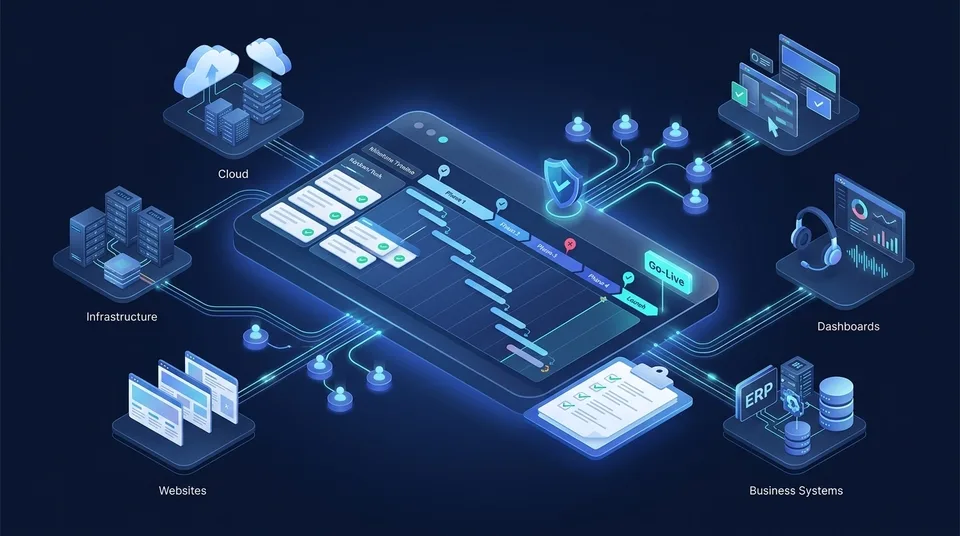
Illustration of consulting and technology modernization project delivery

Capability illustration

Scenarios

Common situations

Signals that this service may be the right starting point.

Growth without technology alignment

What usually happens
Each department adopted its own tools; no one knows which system is authoritative or which data to trust.
What we would examine
Application map, critical flows, data duplication, and dependencies that block decisions.

Half-finished projects with little return

What usually happens
Initiatives started months ago never finish, consume budget, and leave nothing operable behind.
What we would examine
Actual deliverable status, blockers, remaining scope, and value that can still be recovered.

Modernization without clear priorities

What usually happens
Everyone agrees modernization is needed, but there is no alignment on where to start or what impact to expect.
What we would examine
Process gaps, operational risk, estimated effort, and a realistic sequence of interventions.

Compliance or clients demand stronger controls

What usually happens
A client, audit, or regulation asks for control evidence and operations lack traceability or clear governance.
What we would examine
Existing controls, gaps against the requirement, sensitive data, and a prioritized remediation plan.

Assessment

What we review during discovery

Items that typically enter initial assessment scope.

  • Interviews with area leaders and key operational users
  • Inventory of systems, integrations, and critical data sources
  • Review of processes that create rework, delays, or risk
  • Assessment of access, backups, and minimum continuity
  • Analysis of in-flight projects, blockers, and pending deliverables
  • Prioritization by impact, effort, and dependencies between initiatives
  • Identification of quick wins and structural changes
  • Recommendations aligned with budget and team capacity

Before and after

What changes with discipline

Before

  • Long problem lists with no sequence or owner
  • Reactive software purchases without prior diagnosis
  • Projects competing for the same resources
  • Uncertainty about what to modernize first

After

  • Prioritized roadmap with clear phases and criteria
  • Investment decisions based on real gaps
  • Initiatives sequenced with explicit dependencies
  • Team aligned on what to change and in what order

The outcome is an actionable plan, not a generic deck. Assessment depth is calibrated to the size and maturity of your operation.

Fit

Who it is for — and who it is not

Good fit

  • Businesses in Bogotá or Colombia that outgrew their technology base
  • Teams that need to prioritize before investing in more tools
  • Organizations with stalled projects that need a structured restart
  • Leaders who want a roadmap leadership and operations can understand

Clear boundaries

  • We do not replace formal legal audits or regulatory certifications
  • If you only need a quote for a specific product without context, this may not be the right starting point
  • Execution of each phase is scoped separately based on capacity and scope

Scope

What a typical project includes

  1. 01Kickoff with objectives, scope, and key participants
  2. 02Operational and technical information gathering
  3. 03Prioritization workshops with stakeholders
  4. 04Assessment document with findings and gaps
  5. 05Phased roadmap with explicit assumptions
  6. 06Readout session and recommended next steps

Capabilities

Related capabilities

  • Digital transformation
  • IT Projects
  • IT Management / ITSM
  • Governance and compliance
  • IT education and training

Deliverables

What you can expect to receive

  • Executive assessment report
  • Map of relevant systems and dependencies
  • Prioritized gap matrix
  • Phased roadmap with success criteria
  • Quick-win list and risks to monitor
  • Governance and ownership recommendations
  • Directional effort estimate per initiative
  • Follow-up plan to resume execution

Methodology

How we deliver this service

  1. 01

    Context and objectives

    We align on which decisions the assessment should enable and what is out of scope to avoid vague expectations.

  2. 02

    Structured discovery

    Interviews, document review, and walkthroughs of critical processes with people who run daily operations.

  3. 03

    Analysis and prioritization

    We translate findings into gaps with impact, effort, and dependencies to sequence interventions.

  4. 04

    Actionable roadmap

    We define phases, expected deliverables, and progress criteria leadership and operations can track.

  5. 05

    Readout and transition

    We present results, answer questions, and clarify how to resume execution with defined ownership.

FAQ

Questions about this service

How long does a technology assessment take?

It depends on operation size and how many processes or systems are in scope. For an SME with one or two critical fronts, it usually takes two to four weeks combining interviews, document review, and prioritization workshops. Multiple sites or in-flight projects extend the calendar so depth is not sacrificed. We set timelines at kickoff based on what you actually need to decide.

Do I need an internal IT team?

It is not required. We work with companies that have a small IT function, an external provider, or a technical point of contact inside operations. What matters is access to people who know the processes and whoever manages systems or active contracts. If there is no internal owner, we help identify who should take ownership during and after the assessment so the roadmap does not sit unused.

Does the assessment include implementation?

The assessment delivers clarity, priorities, and a roadmap; implementation is quoted by phase based on what we agree to execute. Separating both stages avoids mixing recommendations with sales pressure for a specific product. Many clients continue with us on the first roadmap phase, but the output also helps you bid work or reorganize internal efforts with defined criteria.

Can you assess a project that is already stalled?

Yes, and it is a common scenario. We review original scope, actual deliverables, technical or management blockers, and what value can still be recovered without starting from scratch. The goal is not to blame a previous vendor but to decide whether to resume, reshape, or close out cleanly. That decision is documented with criteria leadership can act on.

Do you work only in Bogotá?

We are based in Bogotá and serve companies across Colombia with remote work and targeted on-site visits when the assessment requires them. For distributed operations we combine virtual interviews with on-site walkthroughs at critical sites. We agree this in initial scope to optimize client team time without losing touch with people who run the process daily.

What information should we prepare?

We do not require perfect documentation; we start with what exists: functional org view, system list, active contracts, diagrams if available, and access to area owners. If little is written down, discovery relies more on interviews. Before kickoff we send a minimal checklist so the start is not delayed by unnecessary bureaucracy.

How is this different from generic consulting?

We connect assessment with real execution capacity across automation, enterprise systems, development, and IT operations. We do not deliver slides disconnected from what can be implemented in a Colombian SME with constrained budget and timelines. Every recommendation is filtered by priority, dependency, and effort so leadership can decide realistically.

How much does a technology assessment for a company cost?

Cost depends on the breadth of the review. Assessing one process is very different from reviewing infrastructure, systems, data, cybersecurity, and operations across multiple locations. The first step is to define which decisions the assessment must support, which areas need to participate, and what evidence is available so a reasonable scope and estimate can be established.

View more questions
Is a technology assessment useful for a small business that grew using Excel and disconnected tools?

Yes. That situation usually requires understanding where data is duplicated, which activities depend on manual work, which tools are genuinely critical, and where access or continuity risks exist. The objective is not to eliminate Excel automatically, but to determine what should remain, be integrated, automated, or replaced.

Can you create a digital transformation roadmap without requiring us to buy new software?

Yes. A useful roadmap should start with business problems, dependencies, and priorities rather than a product list. Some actions may require new tools, while others may be addressed by configuring existing systems better, integrating platforms, improving data, documenting processes, or correcting controls.

Can infrastructure, cybersecurity, systems, data, and IT support be reviewed in the same assessment?

They can be included in the same assessment when the problem requires a cross-functional view. Not every assessment needs the same depth in every domain. The scope should focus on areas that affect real decisions and conclude with priorities, dependencies, and next steps that management can understand.

What does management receive at the end of a technology assessment?

It depends on the agreed scope, but the outcome should turn findings into decisions rather than only a technical list. It can include current state, risks, opportunities, dependencies, and a roadmap. Issues can be organized by risk, impact, effort, and urgency to determine what should be addressed first and what can wait.

How long does a technology assessment take?

It depends on scope, information availability, number of business areas, and environment complexity. A focused review can be completed much faster than an assessment covering multiple locations, systems, infrastructure, and security. The decisions the assessment must support and the evidence that needs review should be defined before committing to a duration.

What access is required for a technology assessment?

Not every assessment requires administrative access on the first day. Work can begin with interviews, inventories, documentation, diagrams, reports, and existing evidence. When direct system or configuration review is required, access should be provided using the minimum level necessary and through controlled mechanisms.

Can a technology assessment identify unnecessary technology spending or licenses?

It can identify duplicated tools, unused capacity, expensive dependencies, or licenses that deserve review, although the objective should not be to promise a specific cost reduction. Each expense should be connected to the function it performs and the risk of changing it before recommending removal or consolidation.

Can you implement the recommendations after the assessment?

Yes, when the recommendations fall within Orquitech's capabilities and a new implementation scope is agreed. Separating assessment from execution allows the company to understand priorities first and then decide which initiatives should be delivered internally, by Orquitech, or by other providers.

Technologies

Frequent platforms and tools

  • Microsoft 365
  • Microsoft Azure
  • Power Platform
  • Entra ID
  • SharePoint
  • Microsoft Teams
  • Power BI

Ready to organize modernization?

Tell us what is slowing your operation and we will propose an assessment scoped to what you need to decide.

Chat on WhatsApp

Contact

Contact us

Reach our team on the channel you prefer. Tell us what you want to improve and we will guide the next step.

WhatsApp

Message us directly to discuss your requirement or project.

Open WhatsApp

Phone

Call our team during regular business hours.

+57 322 810 0001

Call now

Email

Send us the details of your question or project.

info@orqui.tech

Send email

Bogotá office

Carrera 62 #98B-22, Office 302A, Bogotá, Colombia

Get directions
· FREE ISO 27001 REVIEW ·