Uncontrolled access
- What usually happens
- Shared accounts, permissions left active after role changes, and inconsistent multifactor authentication.
- What we would examine
- Identity, user lifecycle, privileges, and authentication on critical systems.
Security and continuity
When access is poorly controlled, backups are untested, or a customer asks for evidence of controls, risk stops being theoretical. We prioritize improvements proportional to your operations.
Access, continuity, or control risks are hard to manage or demonstrate.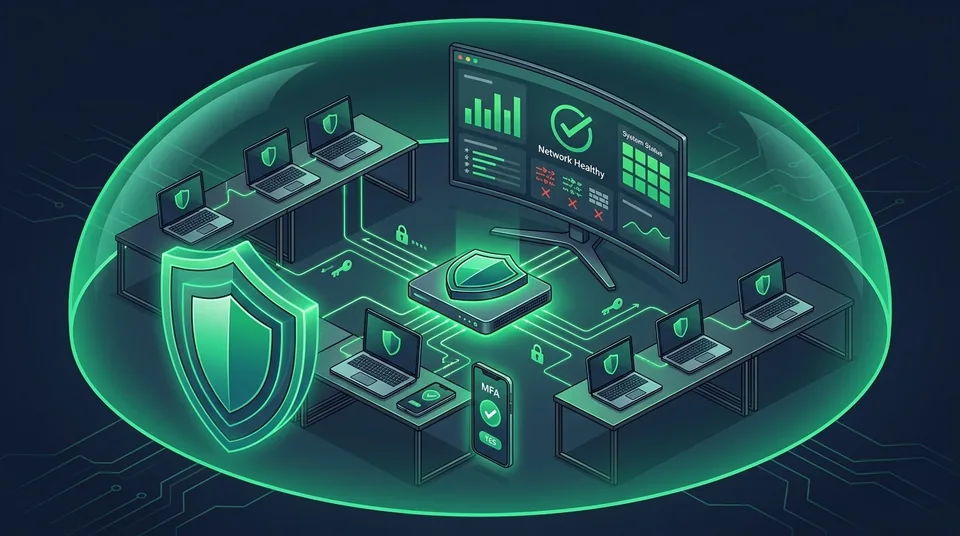
Capability illustration
Scenarios
Signals that this service may be the right starting point.
Assessment
Items that typically enter initial assessment scope.
Proportional controls
Useful security protects what matters without imposing complexity nobody can operate. We prioritize by context and capacity.
Incidents and continuity
Orquitech has experience assessing and implementing ISO 27001 controls. We help organize detection, escalation, and recovery without claiming that the company is certified.
Before and after
Orquitech has experience assessing and implementing ISO 27001 controls. We are not a certification body and do not claim absolute security or compliance.
Fit
Scope
Capabilities
Deliverables
Methodology
We identify which information and systems matter most to operations.
We assess identity, backup, monitoring, policies, and available evidence.
We order findings by impact, likelihood, and remediation effort.
We execute agreed controls and document usable evidence.
We define incident roles, basic exercises, and a follow-up plan.
FAQ
With essentials: individual accounts instead of shared ones, multifactor authentication on critical systems, privilege review, and backups with at least one restoration test. Then organize incident roles and basic evidence. We avoid buying new tools if current ones are not configured. The starting point is real operational risk—not a generic product list.
No. Orquitech has experience assessing and implementing ISO 27001 controls, but is not a certification body and does not issue certificates. We help improve controls, organize evidence, and prepare the organization if it later pursues a formal audit with an independent certifier. That distinction stays explicit in proposals and deliverables.
We inventory privileged accounts, active users, and permissions on agreed systems. We compare them with current roles and departures. We propose corrections, stronger authentication where missing, and a simple joiners-movers-leavers process. The deliverable includes findings and a prioritized backlog—not only a generic best-practice list.
Backup is the copy of data or systems. Business continuity defines which services recover first, who decides, how communication works, and what alternatives exist while restoration runs. Without priorities and roles, a technical backup does not guarantee operations return. We address both levels according to scope.
Yes. We define roles, escalation channels, severity criteria, and initial containment and communication steps. The plan aligns with the company's real systems and suppliers. We also recommend short exercises so the document is usable. We do not promise total incident prevention.
Almost never. First we use what you already have—identity, email, backups, and monitoring. We propose tool changes only when a clear gap cannot be closed with configuration and process. Cost and operating capacity matter as much as technical function. Ethical hacking or other specialized tests are scoped separately when needed.
We combine business impact, ease of exploitation, current exposure, and remediation effort. Findings are ordered into a phased roadmap with suggested owners. We prioritize controls that reduce real risk over cosmetic improvements. Prioritization is reviewed with the company to align budget and capacity.
It depends on users, systems, locations, cloud services, existing controls, and the depth of the review. An access and configuration assessment has a different scope from offensive technical testing or compliance-control preparation. The first step is to define which risks or decisions the assessment needs to address.
Orquitech can support the assessment and implementation of controls, documentation, responsibilities, and evidence within an agreed scope. This does not mean issuing the certification. Formal certification is performed by an appropriate independent certification body.
They can form part of a security engagement when explicitly authorized, scoped, and coordinated to avoid unnecessary operational impact. The type of testing, included assets, execution window, evidence requirements, and remediation process should be defined before any offensive activity takes place.
Yes. Identity and access are often critical parts of a review because they determine who can reach information and services. Authentication, privileged accounts, MFA, permissions, user onboarding and offboarding, and related controls can be evaluated according to the environment and agreed scope.
The first objective is to establish clear priorities and responsibilities. A small business can begin with identity, backups, patching, administrative access, endpoint protection, incident response, and basic evidence. Technology should support those controls rather than replace the operational discipline required to maintain them.
Identity, administrative privileges, patching, endpoint protection, segmentation, backups, recovery, and the ability to detect or respond to incidents are important areas. Priorities depend on the environment. No single product eliminates ransomware risk when access, backups, and operations remain uncontrolled.
It should define how an incident is recognized and reported, who makes decisions, how the issue is contained, what evidence is preserved, how services are recovered, and how communication is handled for the scenario. A useful plan also needs assigned responsibilities and practice; a document nobody knows is unlikely to help during an emergency.
The existence of a backup file does not prove that complete recovery will work. Coverage, retention, access, integrity, and restoration should be evaluated through appropriate testing. System dependencies also need to be understood so services can be recovered in the correct order.
Yes, when they have access to systems, information, or critical services. Their level of access, authentication, responsibilities, and the dependencies created by their service should be understood. An environment can be well protected internally and still remain exposed through a poorly controlled third-party relationship.
Technologies
 Entra ID
 Microsoft 365
 Microsoft Azure
 Cloudflare
Experience
Infrastructure is unstable, hard to operate, or poorly prepared to grow.
We review access, continuity, and evidence with judgment proportional to your operational risk.
Talk about controls and risksContact
Reach our team on the channel you prefer. Tell us what you want to improve and we will guide the next step.
Message us directly to discuss your requirement or project.
Open WhatsAppCall our team during regular business hours.
+57 322 810 0001
Call nowSend us the details of your question or project.
info@orqui.tech
Send emailCarrera 62 #98B-22, Office 302A, Bogotá, Colombia
Get directionsCarrera 62 #98B-22, Office 302A, Bogotá, Colombia