Outdated or unclear website
- What usually happens
- The site does not explain the offer well, loads slowly, or fails to generate useful inquiries.
- What we would examine
- Site goal, content, performance, basic SEO, and conversion from visits to contact.
Digital development
Your digital presence and internal applications should reflect how the business works today, not five years ago. We design and build with continuous delivery and operational discipline.
Your digital presence does not support operations or convert inquiries.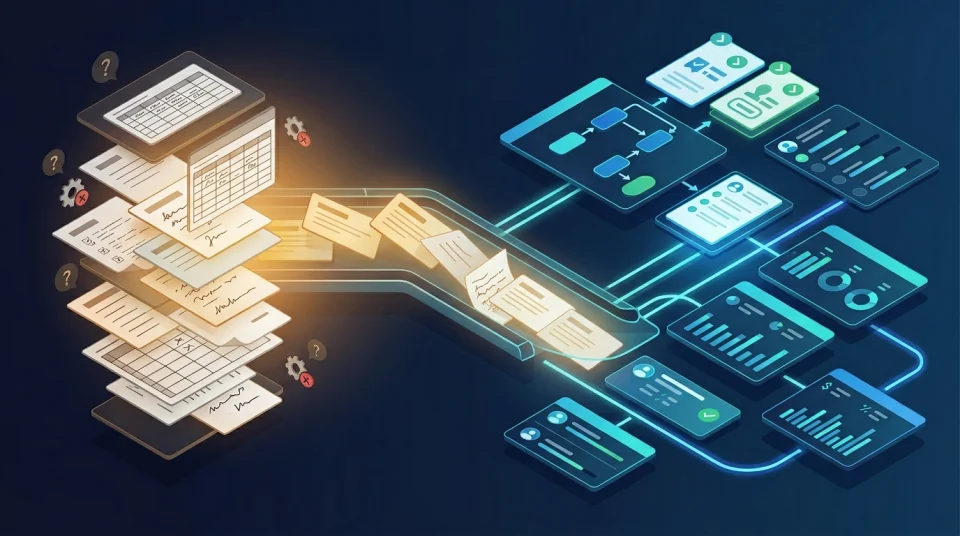
Capability illustration
Scenarios
Signals that this service may be the right starting point.
Assessment
Items that typically enter initial assessment scope.
Digital experience
We design sites, portals, and applications that reflect how your business operates and make it easier for clients and internal teams to interact.
Technical SEO and discovery
We improve how search engines and AI systems understand your site, without promising rankings.
Before and after
We combine useful design with disciplined engineering. We do not deliver code without a clear path to operate and evolve it.
Fit
Scope
Capabilities
Deliverables
Methodology
We define problem, users, integrations, and success criteria before writing code.
We prototype flows, choose stack, and make dependencies on existing systems explicit.
We deliver demonstrable increments with frequent review from the internal sponsor.
We automate tests, builds, and deployments to reduce production surprises.
We document operations, train the team, and agree a post-launch roadmap.
FAQ
We work with modern stacks such as Vue and Node.js, Python where it fits services or integrations, and containers with Docker or Kubernetes depending on scale. We choose technology based on maintainability, client team, and integration needs—not hype. We prefer stacks where we can leave clear documentation and pipelines for whoever operates next.
Yes, we assess content, performance, basic SEO, and conversion—not just visual design. If the current platform is limiting, we propose phased migration to avoid losing ranking or active forms. We agree what is kept, rewritten, and how to measure improvement after launch.
We can deliver responsive experiences and progressive web apps when they cover the use case. Native apps are assessed separately based on store, offline, and device requirements. We prefer not to promise a native app if a well-built web experience solves the problem with lower maintenance cost.
We set up repository, branches, pipelines, and separate dev, test, and production environments. We automate builds and deployments as early as the project allows. We document how to promote changes and who approves releases so you are not dependent on manual late-night deploys.
Yes, the agreed deliverable—including repository and documentation—belongs to the client per contract. We use open-source components and cloud services with standard licenses; relevant dependencies are documented. We do not hold code hostage for mandatory support, though we can support evolution if desired.
Yes, when there are stable APIs or exchange points. We design integrations with error handling, authentication, and logs for reliable operation. If the back office is unstable, we recommend ordering data and processes before building the front. Integration is tested with real cases, not only ideal environments.
We can support fixes, evolution, and operations under a separate service agreement. We deliver documentation so an internal team can maintain the product. Maintenance is sized by criticality, change frequency, and sensitive external integrations.
Cost depends on functionality, content volume, workflows, integrations, authentication, design, infrastructure, and ongoing support. An informational website does not have the same scope as a portal connected to internal systems. The estimate should be built after separating essential capabilities from features that can be delivered in later phases.
Yes, when the problem justifies a custom solution. This can include web applications, portals, internal workflows, and interfaces connecting existing systems. Before building from scratch, it is worth determining whether a configurable platform or integration can solve the problem with lower maintenance complexity.
Yes. The portal can display information, receive requests, exchange documents, or expose status from internal systems. The design should clearly separate external information from private systems through appropriate authentication, permissions, APIs, and controls.
Yes, when the platforms involved provide appropriate integration methods. A website can capture commercial intent and transfer it to CRM, email, automation, or other channels. The implementation should preserve traceability, security, and measurement without adding integrations that do not improve the user journey.
Yes. The current architecture, dependencies, infrastructure, deployment process, and observed problems should be reviewed first. That assessment can identify what should be corrected, modernized, or automated without assuming every existing application needs to be rewritten.
Yes, when the systems provide APIs or other reliable exchange mechanisms. The integration should define authentication, identifiers, errors, limits, and which system owns each piece of data. When a legacy platform has no API, a safe alternative should be evaluated before creating fragile dependencies.
It can integrate with enterprise identity when the architecture, permissions, and platform support it. Central identity can simplify user access and removal, but the application still needs appropriate authorization and internal permissions. Authentication does not mean access to every function.
There should be a model for monitoring, updates, dependencies, security, backups where applicable, and incident handling. Ownership of infrastructure, code, and external services should also be clear. Launching the application does not eliminate the need for operational maintenance.
Technologies
 Vue
Vue Node.js
 Docker
 GitHub
 Cloudflare
Experience
Digital presence or portals do not reflect operations or convert inquiries well.
Tell us if you need a site, application, or portal and we will propose scope with incremental delivery.
Chat on WhatsAppContact
Reach our team on the channel you prefer. Tell us what you want to improve and we will guide the next step.
Message us directly to discuss your requirement or project.
Open WhatsAppCall our team during regular business hours.
+57 322 810 0001
Call nowSend us the details of your question or project.
info@orqui.tech
Send emailCarrera 62 #98B-22, Office 302A, Bogotá, Colombia
Get directionsCarrera 62 #98B-22, Office 302A, Bogotá, Colombia